> ## Documentation Index
> Fetch the complete documentation index at: https://proxy-docs.permify.co/llms.txt
> Use this file to discover all available pages before exploring further.
# Modeling Authorization
In Permify, you can define a user with certain permissions because of their relation to other entities. An example of this would be granting a manager permissions to their subordinates but not to other managers, or giving a user access to a resource because they belong to a certain group.
This is facilitated by our relationship-based access control (ReBAC), which allows you to define complex permission structures based on the relationships between users, roles, and resources.
## Permify Schema
Permify has its own language that you can model your authorization logic with. The language allows you to define arbitrary relations between users and objects.
You can assign users associate them with arbitrary objects representing application concepts, such as teams, organizations, or stores.
You can give users roles such as admin, manager, or member.
You can also use dynamic attributes in your authorization model, such as boolean variables, IP range, or time period.
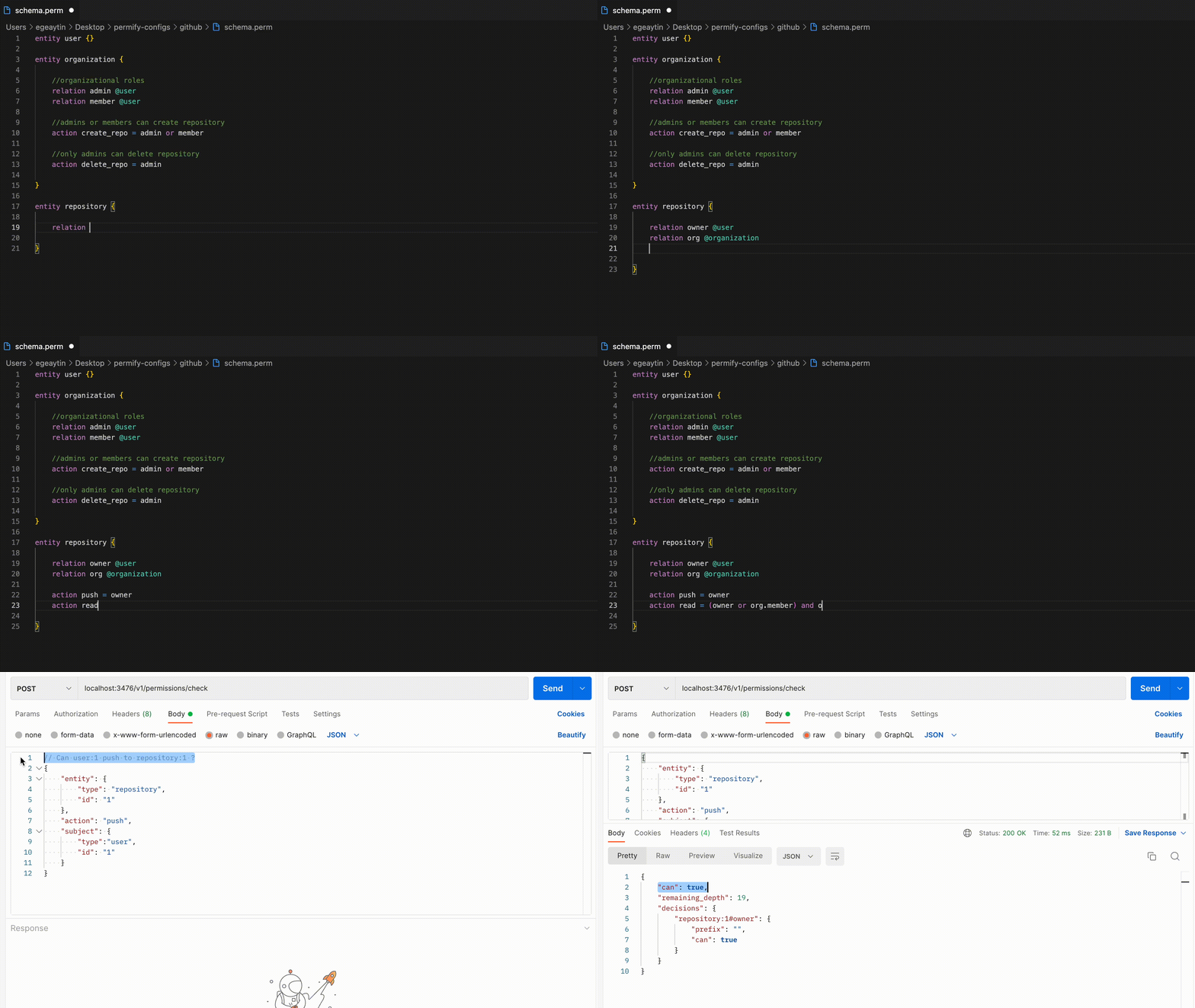
You can define your entities, relations between them and access control decisions using the Permify Schema language. It includes set-algebraic operators such as intersection and union. These allow you to specify complex access control policies in terms of user-object relations.
Here’s a simple breakdown of our schema.

Permify Schema can be created on our [playground](https://play.permify.co/) as well as in any IDE or text editor. We also have a [VS Code extension](https://marketplace.visualstudio.com/items?itemName=Permify.perm) to ease modeling Permify Schema with code snippets and syntax highlights. Note that on VS code the file with extension is ***".perm"***.
## Developing a Schema
This guide will show how to develop a Permify Schema from scratch with an example. It's relatively simple, yet it will illustrate almost every aspect of the modeling language.
We'll follow a simplified version of the GitHub access control system, where teams and organizations have control over the viewing, editing, or deleting access rights for their repositories.
Before we start, here's the full implementation of the simplified Github access control example using Permify Schema.
You can start developing Permify Schema on [VSCode]. You can install the extension by searching for **Perm** in the extensions marketplace.
[vscode]: https://marketplace.visualstudio.com/items?itemName=Permify.perm
## Defining Entities
The first step to building Permify Schema is creating entities. An entity is an object that defines your resources which hold roles in your permission system.
Think of entities as tables in your database. It is strongly recommended to name entities the same as the corresponding database table name. Doing so allows you to model and reason about your authorization and eliminate the possibility of error.
You can create entities using the `entity` keyword. Entity names may contain only letters and underscores and must be at most 64 characters long.
Let's create some entities for our example GitHub authorization logic.
```perm theme={null}
entity user {}
entity organization {}
entity team {}
entity repository {}
```
Entities have a number of different types of properties. These are:
* **relations**: how entities relate to each other
* **actions or permissions**: what can be allowed or denied
* **attributes**: properties of an entity not related to other entities
## Defining Relations
Relations represent relationships between entities. It's the most critical part of the schema because Permify is based on relations between resources and their permissions.
Use the keyword `relation` to create an entity relation with the `name` and `type` properties.
**Relation Attributes:**
* **name:** the name of the relation, may contain only letters and underscores and must be at most 64 characters long
* **type:** the target entity type this relation references (e.g. user, organization, document), which must exist in the schema
Here's an example of a relation.
```perm theme={null}
relation name @type
```
Let's turn back to our example and define relations inside our entities:
### User Entity
→ The user entity is a mandatory entity in Permify. It generally will be empty, but it will be used in other entities as a relation type referencing users.
```perm theme={null}
entity user {}
```
### Roles and User Types
You can define user types and roles within an entity. If you want a global role, such as `admin`, define it at the entity highest in the global hierarchy, such as an organization. Then, share it with the rest of the entities by including it within permissions.
For the sake of simplicity, let's define only two user types in our organization: administrators and members of the organization.
```perm theme={null}
entity organization {
relation admin @user
relation member @user
}
```
### Parent-Child Relationship
→ Let's say teams can belong to organizations and can have members. We model that as follows:
```perm theme={null}
entity organization {
relation admin @user
relation member @user
}
entity team {
relation parent @organization
relation member @user
}
```
The parent relation indicates the organization to which the team belongs. You now have a **parent-child relationship** between these entities.
### Ownership
In the simple GitHub example we are following, organizations and users can have multiple repositories. Each repository is related with an organization and with users. The repository entity is defined as follows:
```perm theme={null}
entity repository {
relation parent @organization
relation owner @user
relation maintainer @user @team#member
}
```
The owner relation indicates the creator of the repository. This is how you can define **ownership** in a Permify schema.
### Multiple Relation Types
You may have noticed new syntax above:
```perm theme={null}
relation maintainer @user @team#member
```
The maintainer relation shows that the maintainer can either be a `user` or that this user must be a `team member`.
You can use **#** character to reach an entity's relation. `@team#member` specifies that if the user has a relation with the team, this relation must be a `member` relation. This is called feature locking, because it locks the relation type to that of the prefixed entity. No other relation on `@team` will be allowed.
Feature locking allows you to specify sets of assigned users.
For example:
```perm theme={null}
relation viewer @user
```
When you define the relation like this, you can only add users directly as tuples. (You will learn about tuples in the next section.) For example:
* organization:1#viewer\@user:U1
* organization:1#viewer\@user:U2
However, if you define it using both `@user` and `@organization#member` :
```perm theme={null}
relation viewer @user @organization#member
```
You then can specify not only individual users but also members of an organization as a tuple:
* organization:1#viewer\@user:U1
* organization:1#viewer\@user:U2
* organization:1#viewer\@organization:O1#member
With `organization:1#viewer@organization:O1#member`, all members of the organization O1 will have the right to perform the defined action. In this case, all members in O1 now have the `viewer` relation.
These definitions prevent you from creating undesired user set relationships.
Defining multiple relation types is optional, but it improves validation and reasonability. For complex models, using multiple relation types allow you to model your entities in a more structured way.
## Defining Permissions
Actions describe what relations, or a relation’s relation can do. They are permissions of the entity to which the action belongs. Actions define who can perform a specific action on an entity, and in which circumstances.
The basic form of an authorization check in Permify is ***Can the user U perform action X on a resource Y ?***.
The keywords ***action*** or ***permission*** are equivalent.
### Intersection and Exclusion
The Permify Schema supports **`and`**, **`or`** and **`not`** operators. These offer you permission **intersection** and **exclusion**. You can use these in combination with actions to define complex authorization logic.
#### Intersection
Let's get back to our GitHub example and create a read action on the repository entity to show an example of the **`and`** and **`or`** operators.
```perm theme={null}
entity repository {
relation parent @organization
relation owner @user
relation maintainer @user @team#member
..
..
action delete = organization.admin and (owner or maintainer or organization.member)
}
```
→ Looking at the `delete` action, you can see the permission is limited to a user that is an `organization admin` and also has one of the following relations: `owner` of the repository, or `maintainer`, or `member` of the organization which repository belongs to.
The same `delete` action can also be defined using the **permission** keyword, as follows:
```perm theme={null}
permission delete = org.admin and (owner or maintainer or org.member)
```
Using the `action` or `permission` keywords yields the same authorization logic. We have two keywords for defining a permission because most, but not all, permissions are based on actions. Learn more in our [Nested Hierarchies](/modeling-guides/rebac/impersonation) section.
The `and` operator intersects the resolved user sets of its operands.
For an expression such as `org.member and org.admin`, Permify evaluates `org.member` and `org.admin` independently across all organizations reachable through `org`, and then intersects the resulting user sets.
Use this pattern when you want intersection across the users reachable through all related organizations:
```perm theme={null}
entity user {}
entity organization {
relation member @user
relation admin @user
}
entity repository {
relation org @organization
permission delete = org.member and org.admin
}
```
If a repository is related to multiple organizations, a user can satisfy `org.member and org.admin` by being a `member` of one related organization and an `admin` of another.
If you need both relations to be satisfied on the same organization, define the intersection on `organization` and reference that permission from `repository`:
```perm theme={null}
entity user {}
entity organization {
relation member @user
relation admin @user
permission delete = member and admin
}
entity repository {
relation org @organization
permission delete = org.delete
}
```
In this version, `member and admin` is evaluated within each organization first, so `repository.delete` is granted only if the user satisfies both relations on at least one related organization.
#### Exclusion
We'll now move beyond the GitHub example and explore more advanced abilities of the Permify Schema.
Let's examine the **`not`** operator.
Here is the **post** entity from our sample [Instagram Authorization Structure](./examples/instagram) example,
```perm theme={null}
entity post {
// posts are linked with accounts.
relation account @account
// comments are limited to people followed by the parent account.
attribute restricted boolean
..
..
// users can comment and like on unrestricted posts or posts by owners who follow them.
action comment = account.following not restricted
action like = account.following not restricted
}
```
As you can see from the comment and like actions, a user tagged with the `restricted` attribute won't be able to like or comment on the specific post. More details about defining attributes can be found in the [Attribute Based Permissions (ABAC)](#attribute-based-permissions-abac) section.
With the `not` operator, you can exclude users, resources, or any subject from permissions.
### Permission Union
Permify allows you to set permissions that are the union of multiple permission sets.
You can define permissions as relations. You can use actions (or permissions) when defining another action (or permission):
```perm theme={null}
action edit = member or manager
action delete = edit or organization.admin
```
The `delete` action inherits from the `edit` action. Both organization administrators and any relation capable of performing the `edit` action (in this case, a member or manager) can also perform the `delete` action.
Creating permission unions is beneficial when a user needs to have access across different departments or roles.
Let's examine our modeling guides for common permission use cases.
## Attribute Based Permissions (ABAC)
To support Attribute Based Access Control (ABAC), there are two additional components in our schema language: `attribute` and `rule`.
### Defining Attributes
Attributes define properties for entities with specific data types. For instance, an attribute could be an IP range associated with an organization, defined as a string array:
```perm theme={null}
attribute ip_range string[]
```
Here are the different attribute types that you use when defining an `attribute`.
```perm theme={null}
// A boolean attribute type
boolean
// A boolean array attribute type.
boolean[]
// A string attribute type.
string
// A string array attribute type.
string[]
// An integer attribute type.
integer
// An integer array attribute type.
integer[]
// A double attribute type.
double
// A double array attribute type.
double[]
```
### Defining Rules
Rules allow you to write conditions for the model. These are similar to functions that every software language has. They accept parameters and, based on conditions, return either a true or a false value.
In the following example schema, the `check_ip_range` rule checks if a given IP address falls within a specified IP range:
```perm theme={null}
entity user {}
entity organization {
relation admin @user
attribute ip_range string[]
permission view = check_ip_range(ip_range) or admin
}
rule check_ip_range(ip_range string[]) {
context.data.ip in ip_range
}
```
We designed our schema language based on [Common Expression Language (CEL)](https://github.com/google/cel-go). The syntax looks nearly identical to equivalent expressions in C++, Go, Java, and TypeScript.
Please let us know via our [Discord channel](https://discord.gg/permify) if you have questions regarding syntax, definitions or any operator you identify not working as expected.
## Modeling Guides
Our modeling guides offer specific examples of common permission use cases.
**Role-Based Access Control (RBAC)**
* [Global Roles](/modeling-guides/rbac/global-roles)
* [Resource Specific Roles](/modeling-guides/rbac/resource-specific-roles)
* [Custom Roles](/modeling-guides/rbac/custom-roles)
**Relationship Based Access Control (ReBAC)**
* [User Groups](/modeling-guides/rebac/user-groups)
* [Hierarchies](/modeling-guides/rebac/hierarchies)
* [Nested/Inherited Permissions](/modeling-guides/rebac/impersonation)
* [Recursive Relationships](/modeling-guides/rebac/recursive-rebac)
**Attribute Based Access Control (ABAC)**
* [Public or Private Resources](/modeling-guides/abac/public-private)
* [Text & Object Based Conditions](/modeling-guides/abac/text-object-based-conditions)
* [Numerical Conditions](/modeling-guides/abac/numerical-conditions)
## More Comprehensive Examples
You can also check out comprehensive schema examples from the [Real World Examples](/getting-started/examples/intro) section.
Here is what each example focuses on,
* [Google Docs]: how users can gain direct access to a document through **organizational roles** or through **inherited/nested permissions**.
* [Facebook Groups]: how users can perform various actions based on the **roles and permissions within the groups** to which they belong.
* [Notion]: how **one global entity (workspace) can manage access rights** in the child entities that belong to it.
* [Instagram]: how **public/private attributes** can play a role in granting access to specific users.
* [Mercury]: how **attributes and rules** interact within the hierarchical relationships.
[Google Docs]: ./examples/google-docs
[Facebook Groups]: ./examples/facebook-groups
[Notion]: ./examples/notion
[Instagram]: ./examples/instagram
[Mercury]: ./examples/mercury